

1 Point: Student did not master outcome
Student Learning Outcomes
At Bridges Christian College & Seminary, student learning and ministry readiness are central to our mission. Program outcomes are measured annually to ensure growth in Biblical knowledge, leadership, and Spirit-empowered practice, supporting both academic excellence and effective service in ministry.
Overview
Bridges Christian College & Seminary evaluates all academic programs using a 3-point Likert Scale to assess learning outcomes.
Goal: An average score of 2.5 or greater, representing performance above moderate accomplishment.
Evaluation Rubric

2 Points: Student moderately mastered outcome
3 Points: Student significantly mastered outcome
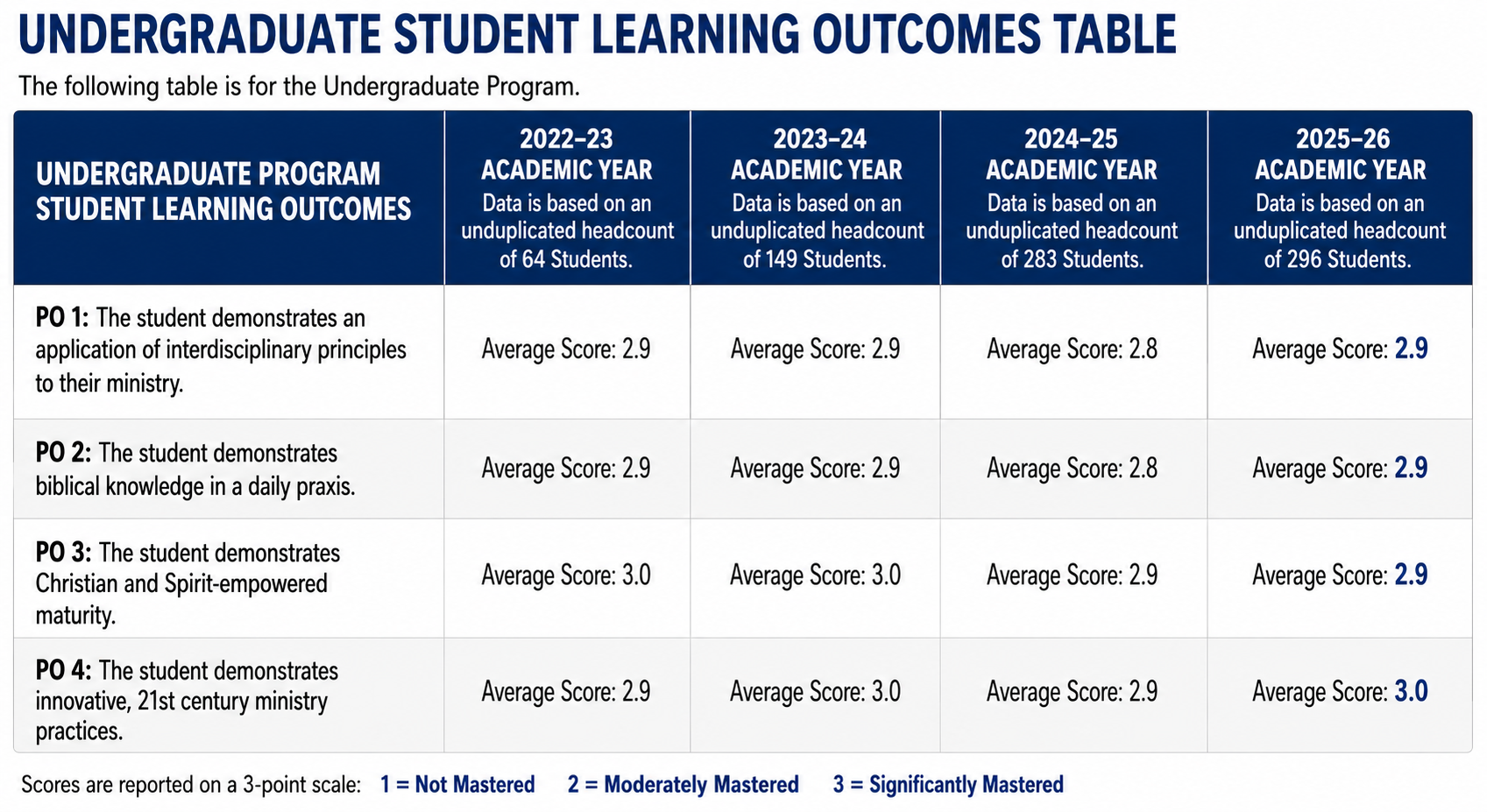
Undergraduate Student Learning Outcomes Table
Frequently Asked Questions
B.A. in Biblical Studies Learning Outcomes
Program Student Learning Outcomes
- The student demonstrates an application of interdisciplinary principles to their ministry.
- The student demonstrates biblical knowledge in a daily praxis.
- The student demonstrates Christian and Spirit-empowered maturity.
- The student demonstrates innovative, 21st century ministry practices.
BCCS’s Student Learning Outcomes are italicized. The elements which support the academic outcomes are listed below (A = Affective Elements, C = Cognitive Elements, and P= Professional Development Elements).
1. The student demonstrates an application of interdisciplinary principles to their ministry.
- Develop an appreciation for the various academic disciplines. (A)
- Demonstrate knowledge of key historical facts, values, and ideas that have shaped civilizations throughout history. ©
- Demonstrate broad content knowledge in general studies and their application in church administration. ©
- Demonstrate responsible use of technology, media, and resources for research and ministry. (P)
- Research, write and present written communication through reviews, research papers, and correspondence which reflects college-level critical thinking and Christian demeanor. (P)
2. The student demonstrates biblical knowledge in a daily praxis.
- Appreciate the Bible as a source for truth and life practices. (A)
- Embrace the need for disciplined study, research, and work ethic. (A)
- Outline the biblical basis and historical development for the work and support of global missions. ©
- Be conversant with a variety of theological positions, while distinguishing theologically sound doctrine, false teaching, and cultural traditions. ©
- Be conversant with principles of consistent exegesis, using basic reference resources, which acknowledge genre, context, historical background and semantic domains of biblical texts. (C)
- Research, write and present written communication through reviews, research papers, and correspondence which reflects college-level critical thinking and Christian demeanor. (P)
3. The student demonstrates Christian and Spirit-empowered maturity.
- Express an understanding of one’s unique gifts, personality, experiences, and passions as an individual in the kingdom of God. (A)
- Demonstrate one’s faith in Christ through the well-being of the whole person. (A)
- Develop a biblical basis for a Spirit-filled life. (C)
- The ability to integrate biblical knowledge into one’s personal thought life in such a way that the mind is renewed and transformed. (C)
- Develop quality Spirit-empowered preaching and teaching materials in order to effectively communicate the gospel and make disciples. (P)
4. The student demonstrates innovative, 21st century ministry practices.
- Value participation and leadership in the local church as it expresses the Kingdom of God in the world. (A)
- Demonstrate an understanding of how diverse cultural structures and social organizations impact the communication of the gospel and the work of ministry. ©
- Articulate principles of developing an integrated support system and leadership team within the local Christian context, reflecting biblical principles in ministry leadership, selection of church models, and ministry methodologies. ©
- Develop quality Spirit-empowered preaching and teaching materials in order to effectively communicate the gospel. (P)
- Demonstrate responsible use of technology, media, and resources for research and ministry. (P)
- Provide biblical counsel to others. (P)
Graduate Programs
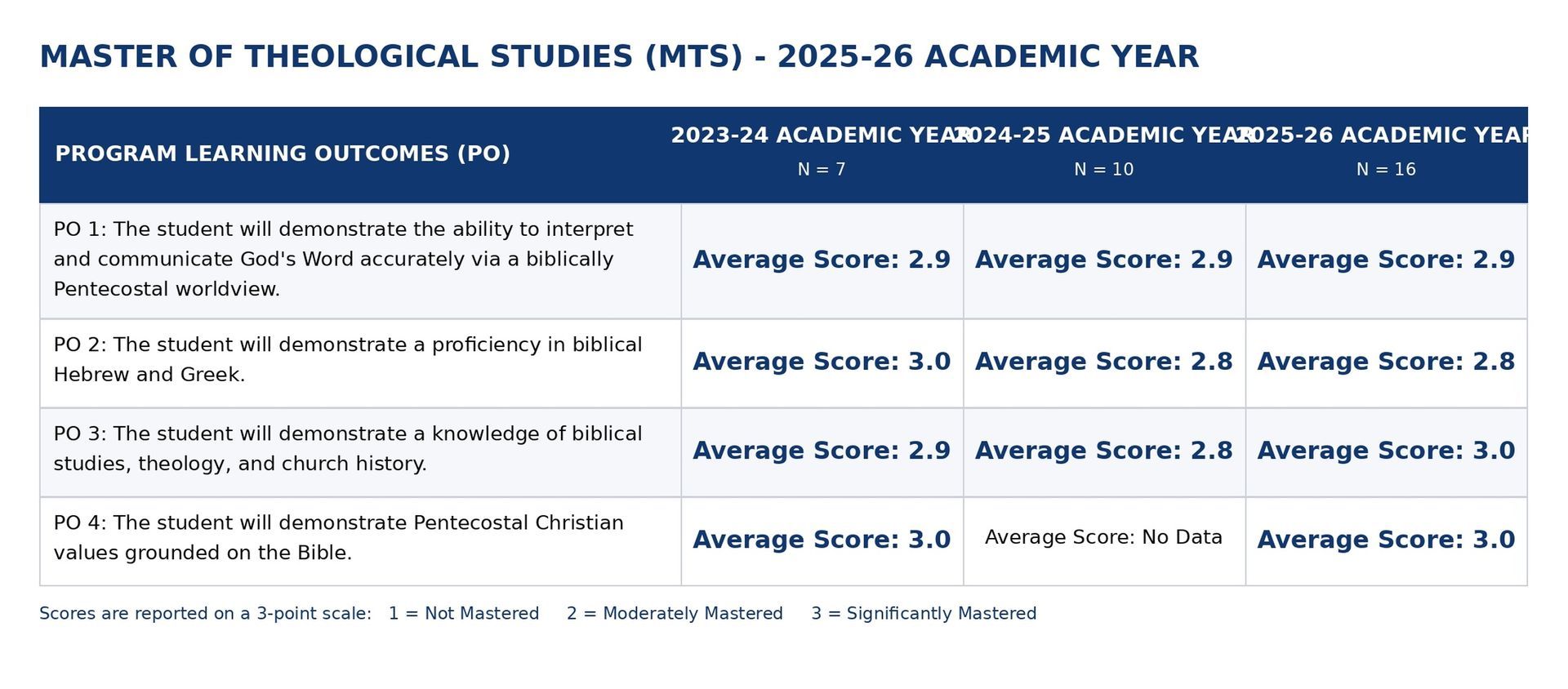
Master of Theological Studies (MTS) Program Student Learning Outcomes Table
The following table is for the MTS program.
Frequently Asked Questions
MTS Program Learning Outcomes
Each program student learning outcome (PO) is supported by student learning outcome elements. The student learning outcome elements cover professional (P), affective (A), and cognitive (C) student learning outcomes.
(PO1) The student will demonstrate the ability to interpret and communicate God’s Word accurately via a biblically Pentecostal worldview.
- (P1) The student will demonstrate proper implementation of Pentecostal-biblical-hermeneutical principles and their application to the modern believer via teaching, preaching, research, and writing.
- (A1) The student will demonstrate an appreciation for interpretive models contrary to his/her theological worldview.
- (C1) The student will demonstrate a historical and theological understanding of hermeneutical principles.
(PO2) The student will demonstrate a proficiency in biblical Hebrew and Greek.
- (P2) The student will effectively translate texts of the biblical Hebrew and Greek.
- (A2) The student will display confidence in discussing the importance biblical Hebrew and Greek have on textual studies.
- (C2) The student will demonstrate knowledge of biblical Hebrew and Greek vocabulary, grammar, and syntax.
(PO3) The student will demonstrate a knowledge of biblical studies, theology, and church history.
- (P3) The student will compare and contrast varying theological perspectives.
- (A3) The student will apply theological perspectives to his or her Christian life.
- (C3) The student will display a grasp of biblical, theological, and historical concepts.
(PO4) The student will demonstrate Pentecostal Christian values grounded on the Bible.
- (P4) The student will portray habits grounded on the Bible within a ministry context.
- (A4) The student will exhibit a passion for Pentecostal ministry in everyday life.
- (C4) The student will illustrate what it means to be a Pentecostal Christian according to the Bible.
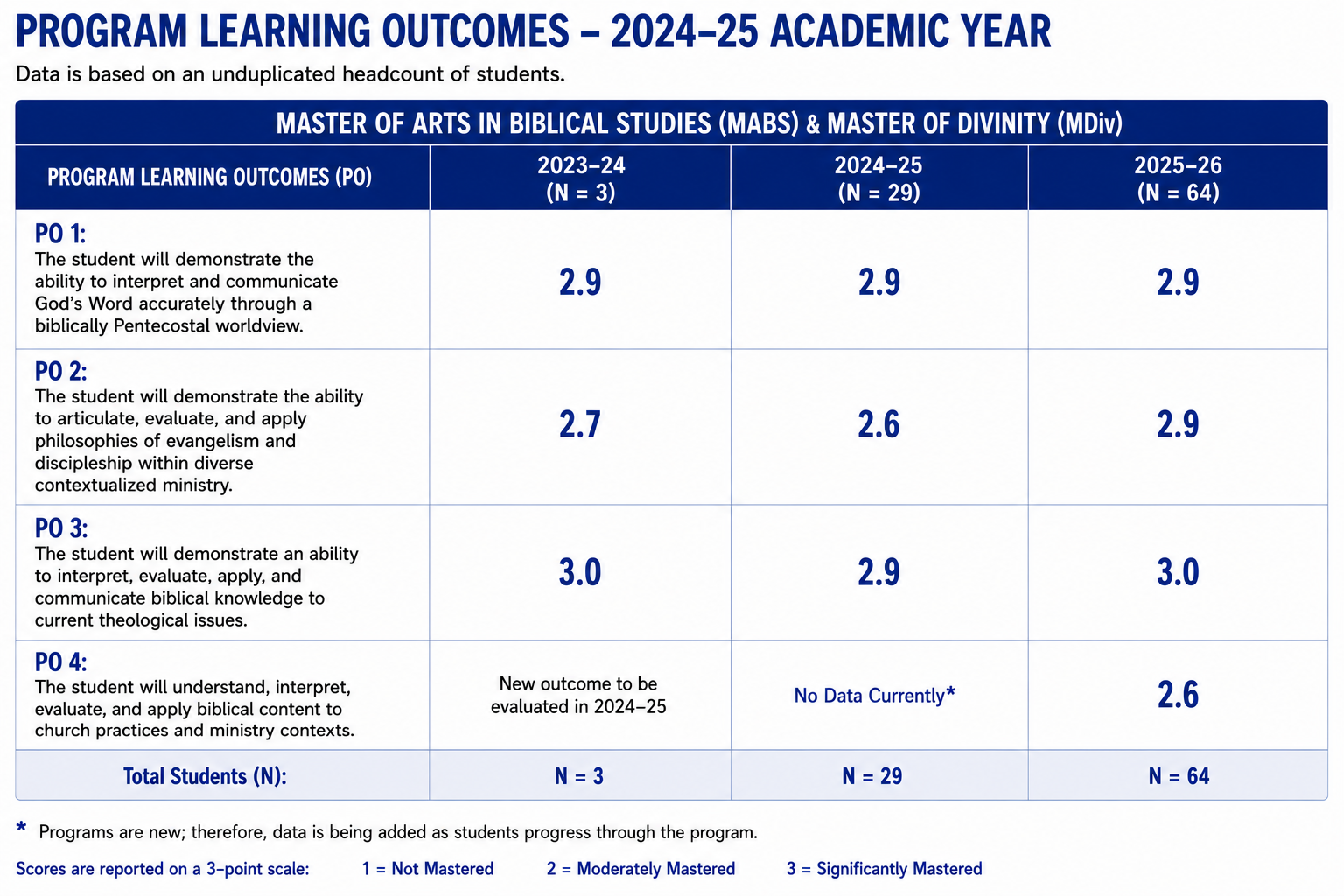
Master of Arts in Biblical Studies and Master of Divinity Program Student Learning Outcomes Table
The following table is for the MABS and MDiv programs.
Frequently Asked Questions
M.A.B.S. Student Learning Outcomes
Each program student learning outcome (PO) is supported by student learning outcome elements. The student learning outcome elements cover professional (P), affective (A), and cognitive (C) student learning outcomes.
(PO1) The student will demonstrate the ability to interpret and communicate God’s Word accurately through a biblically Pentecostal worldview.
- (P1) The student will demonstrate proper implementation of Pentecostal-biblical-hermeneutical principles and their application to the modern believer via teaching, preaching, research, and writing.
- (A1) The student will demonstrate an appreciation for interpretive models contrary to his/her theological worldview.
- (C1) The student will demonstrate a historical and theological understanding of hermeneutical principles.
(PO2) The student will demonstrate the ability to articulate, evaluate, and apply philosophies of evangelism and discipleship within diverse contextualized ministry.
- (P2) The student will apply philosophies and strategies for evangelism, discipleship and Biblical servant leadership within contextualized ministry.
- (A2) The student will indicate a concern for the lost and develop practical habits and strategies to fulfill the Great Commission.
- (C2) The student will demonstrate an understanding of the philosophies of evangelism and discipleship by effectively communicating and applying various strategies and perspectives to local ministry contexts through writing, teaching, and preaching.
(PO3) The student will demonstrate an ability to interpret, evaluate, apply, and communicate biblical knowledge to current theological issues.
- (P3) The student will apply biblical and content knowledge to practical theological issues by comparing varying theological perspectives.
- (A3) The student will portray an appreciation for various theological positions different from his/her own through class discussion and research.
- (C3) The student will display an understanding of current practical theological issues.
M.Div. Student Learning Outcomes
Each program student learning outcome (PO) is supported by student learning outcome elements. The student learning outcome elements cover professional (P), affective (A), and cognitive (C) student learning outcomes.
(PO1) The student will demonstrate the ability to interpret and communicate God’s Word accurately through a biblically Pentecostal worldview.
- (P1) The student will demonstrate proper implementation of Pentecostal-biblical-hermeneutical principles and their application to the modern believer via teaching, preaching, research, and writing.
- (A1) The student will demonstrate an appreciation for interpretive models contrary to his/her theological worldview.
- (C1) The student will demonstrate a historical and theological understanding of hermeneutical principles.
(PO2) The student will demonstrate the ability to articulate, evaluate, and apply philosophies of evangelism and discipleship within diverse contextualized ministry.
- (P2) The student will apply philosophies and strategies for evangelism, discipleship and Biblical servant leadership within contextualized ministry.
- (A2) The student will indicate a concern for the lost and develop practical habits and strategies to fulfill the Great Commission.
- (C2) The student will demonstrate an understanding of the philosophies of evangelism and discipleship by effectively communicating and applying various strategies and perspectives to local ministry contexts through writing, teaching, and preaching.
(PO3) The student will demonstrate an ability to interpret, evaluate, apply, and communicate biblical knowledge to current theological issues.
- (P3) The student will apply biblical and content knowledge to practical theological issues by comparing varying theological perspectives.
- (A3) The student will portray an appreciation for various theological positions different from his/her own through class discussion and research.
- (C3) The student will display an understanding of current practical theological issues.
(PO4) The student will understand, interpret, evaluate, and apply biblical content to church practices and ministry contexts.
- (P4) The student will compare and contrast varying theological perspectives.
- (A4) The student will exhibit an appreciation for differing ecclesiological practices within the diverse local ministry context through discussion.
- (C4) The student will demonstrate an understanding of the varying ecclesiological views and practices in diverse local ministry contexts while properly interpreting scripture.
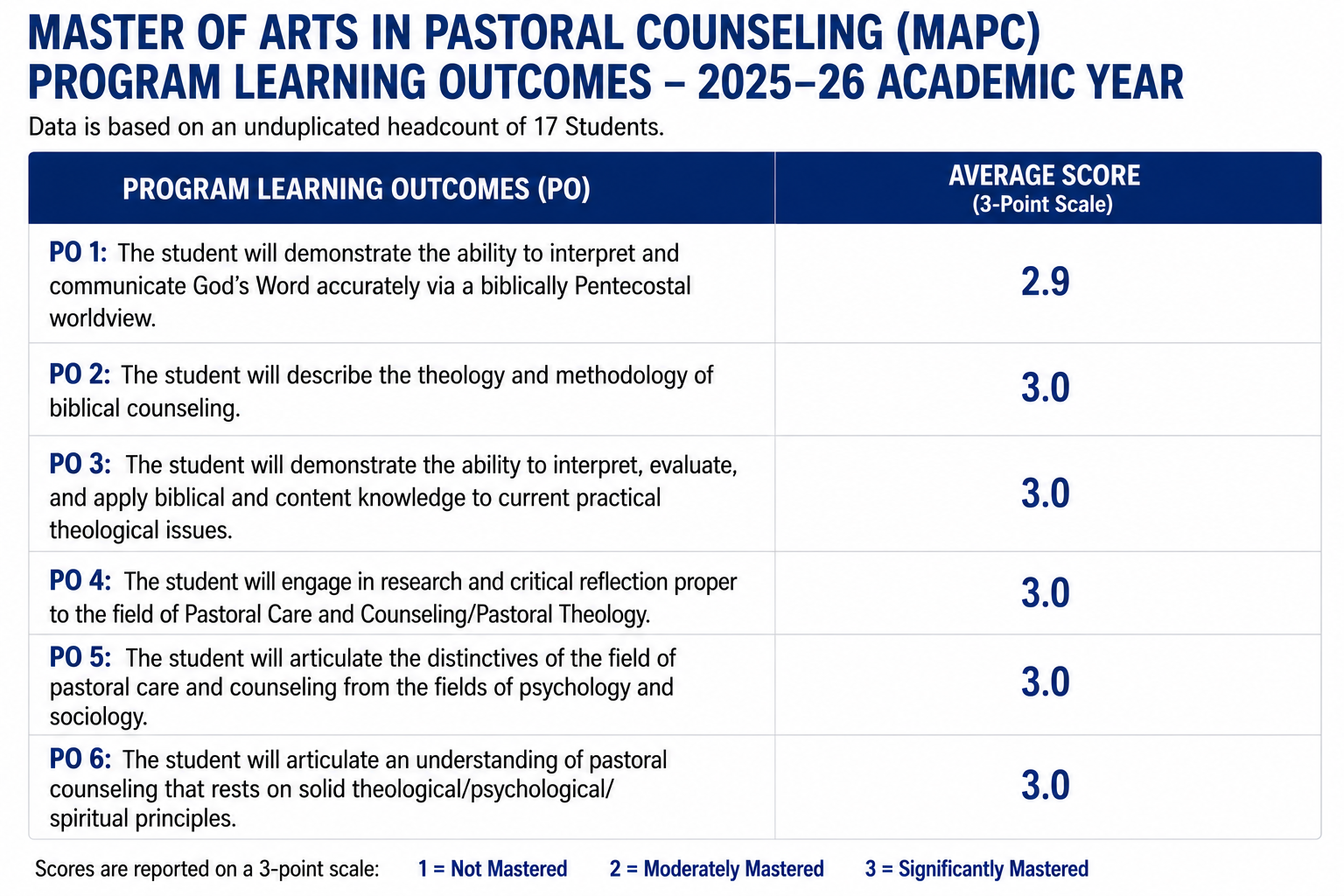
Master of Arts in Pastoral Counseling Program Student Learning Outcomes Table
The following table is for the MAPC programs.
Frequently Asked Questions
M.A.P.C. Student Learning Outcomes
Each program student learning outcome (PO) is supported by student learning outcome elements. The student learning outcome elements cover professional (P), affective (A), and cognitive (C) student learning outcomes.
(PO1) The student will demonstrate the ability to interpret and communicate God’s Word accurately via a biblically Pentecostal worldview.
- (P1) The student will demonstrate proper implementation of Pentecostal-biblical-hermeneutical principles and their application to the modern believer via teaching, preaching, research, and writing.
- (A1) The student will demonstrate an appreciation for interpretive models contrary to his/her theological worldview.
- (C1) The student will demonstrate a historical and theological understanding of hermeneutical principles.
(PO2) The student will describe the theology and methodology of biblical counseling.
- (P2) The student will demonstrate proper implementation of Pentecostal-biblical-hermeneutical principles and their application to the practice of pastoral counseling.
- (A2) The student will demonstrate competence and awareness of various psychological methods.
- (C2) The student will demonstrate historical models of psychology and their relationship to competent pastoral counseling.
(PO3) The student will demonstrate the ability to interpret, evaluate, and apply biblical and content knowledge to current practical theological issues.
- (P3)The student will demonstrate the proper application of biblical and content knowledge to practical theological issues.
- (A3) The student will demonstrate an appreciation for practical theological positions different to his/her own.
- (C3) The student will demonstrate an understanding of current practical theological issues.
(PO4) The student will engage in research and critical reflection proper to the field of Pastoral Care and Counseling/Pastoral Theology.
- (P4) The student will demonstrate the ability to apply appropriate counseling techniques based on sound biblical and psychological principles.
- (A4) The student will demonstrate the application of differing perspectives of counseling techniques.
- (C4) The student will demonstrate an understanding of psychological constructs related to pastoral counseling.
(PO5) The student will articulate the distinctives of the field of pastoral care and counseling from the fields of psychology and sociology.
- (P5) The student will demonstrate the proper application of psychological and sociological theories in terms of pastoral counseling.
- (A5) The student will demonstrate an understanding of counseling principles in congruence with sound biblical principles.
- (C5) The student will demonstrate an understanding of current counseling techniques from various methodologies.
(PO6) The student will articulate an understanding of pastoral counseling that rests on solid theological/psychological/spiritual principles.
- (P6) The student will demonstrate an understanding of ethical counseling practice.
- (A6) The student will demonstrate an understanding of pastoral counseling practice consistent with the Pentecostal perspective.
- (C6) The student will demonstrate an understanding of the application of different counseling practices in cross-cultural settings.
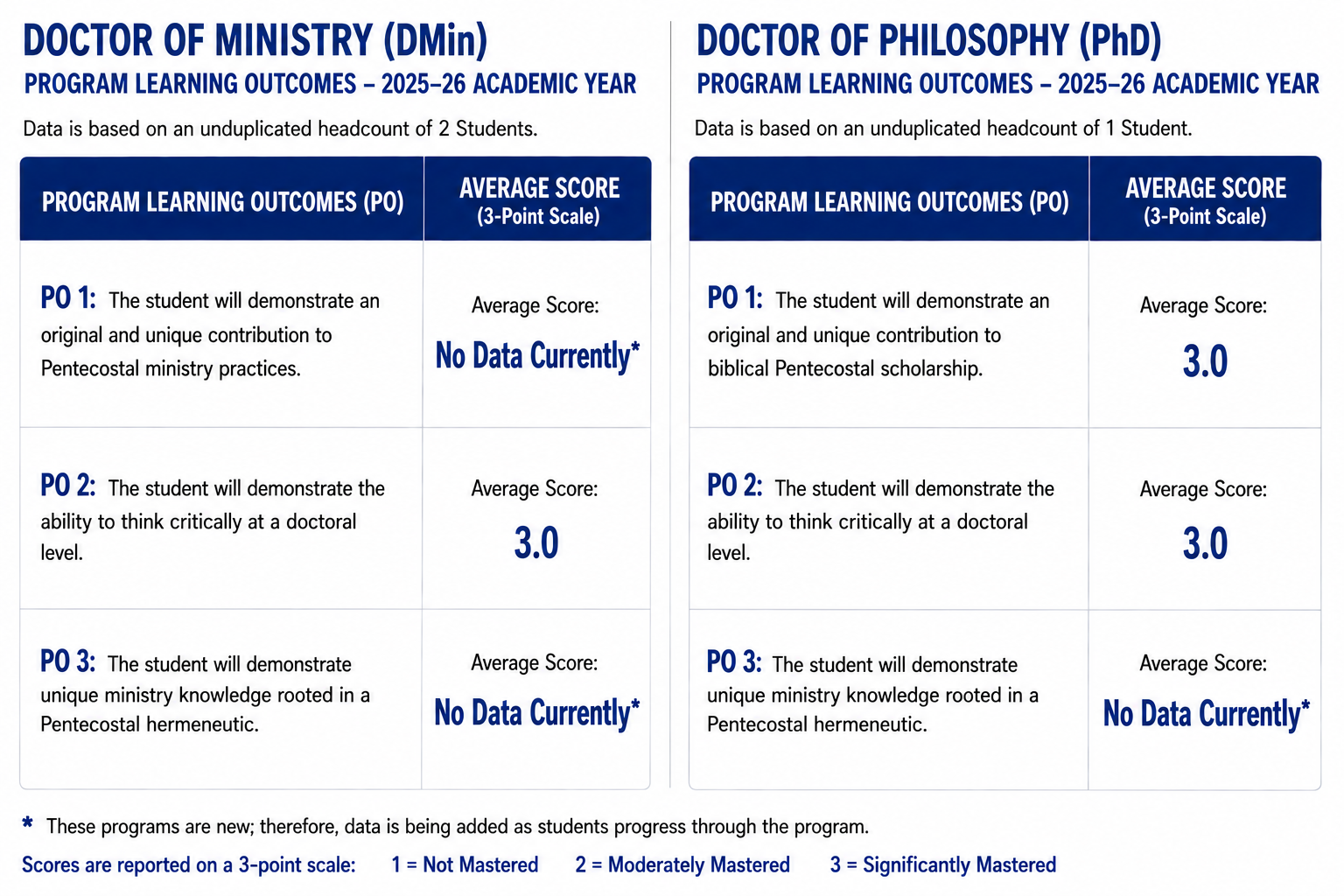
Doctorate STUDENT LEARNING OUTCOMES
Frequently Asked Questions
Doctor of Philosophy Student Learning Outcomes
Each program student learning outcome (PO) is supported by student learning outcome elements. The student learning outcome elements cover professional (P), affective (A), and cognitive (C) student learning outcomes.
PhD 1: The student will demonstrate an original and unique contribution to biblical Pentecostal scholarship.
- PhD 1 (A): Students will appreciate their unique ministry experience as they study.
- PhD 1 (P): The student will compose a project showing an original contribution to biblical Pentecostal scholarship.
- PhD 1 (C) The student will exhibit knowledge in the area of biblical Pentecostal scholarship through writing and research.
PhD 2: The student will demonstrate the ability to think critically at a doctoral level.
- PhD 2 (A) The student will demonstrate critical thinking at the doctoral level by appreciating quality approaches to research methodologies.
- PhD 2 (P) The student will demonstrate critical thinking at the doctoral level by collecting and analyzing high quality research.
- PhD 2 (C) The student will demonstrate critical thinking at the doctoral level by developing a biblical Pentecostal framework.
PhD 3: The student will demonstrate unique ministry knowledge rooted in a Pentecostal hermeneutic.
- PhD 3 (A) The student will appreciate the Pentecostal hermeneutic in his or her written work.
- PhD 3 (P) The student will exegete the Scriptures and apply the theological principle to a modern Pentecostal ministry context.
- PhD 3 (C) The student will demonstrate knowledge of a Pentecostal hermeneutic.
DMin Student Learning Outcomes
Each program student learning outcome (PO) is supported by student learning outcome elements. The student learning outcome elements cover professional (P), affective (A), and cognitive (C) student learning outcomes.
(DMin PO 1): The student will demonstrate an original and unique contribution to Pentecostal ministry practices.
- DMin 1 (A): The student will appreciate their unique ministry experience as they study.
- DMin 1 (P): The student will compose a project showing an original contribution to Pentecostal ministry practices.
- DMin 1 (C) The student will exhibit knowledge in the area of Pentecostal ministry through writing and research.
(DMin PO 2)The student will demonstrate the ability to think critically at a doctoral level.
- DMin 2 (A) The student will demonstrate critical thinking at the doctoral level by appreciating quality approaches to research methodologies.
- DMin 2 (P) The student will demonstrate critical thinking at the doctoral level by collecting and analyzing high quality research.
- DMin 2 (C) The student will demonstrate critical thinking at the doctoral level by applying knowledge to practical ministry research.
(DMin PO 3): The student will demonstrate unique ministry knowledge rooted in a Pentecostal hermeneutic.
- DMin 3 (A) The student will appreciate the Pentecostal hermeneutic in their written work.
- DMin 3 (P) The student will exegete the Scriptures and apply the theological principle to a modern Pentecostal ministry context.
- DMin 3 (C) The student will demonstrate knowledge of a Pentecostal hermeneutic.